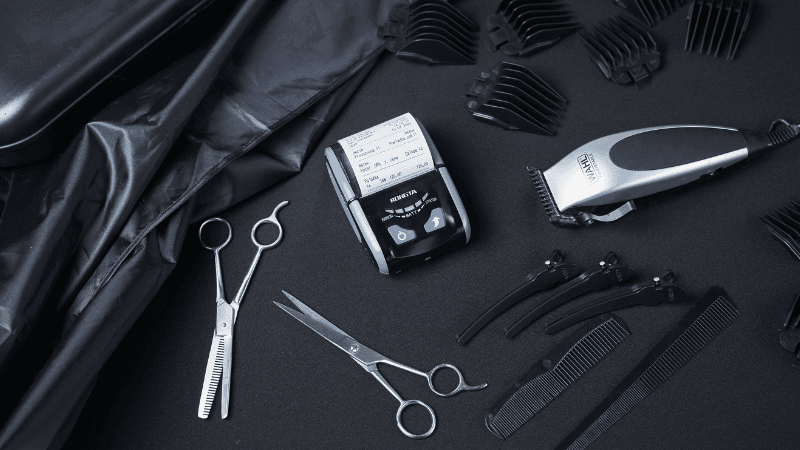
Clipper or scissors haircut: what do barbers really choose and why?
The client in the chair almost always formulates their request the same way: "Make it shorter, but not like with clippers." Five minutes later, it turns out that the barber is actually using clippers on the sideburns—just not so roughly. The difference between a haircut with clippers or scissors isn't in which tool is "more appropriate," but in the purpose for which the barber uses it. If you're looking fora men's haircut in Kharkiv and want to understand what's going on in the chair, it's worth first understanding the rationale behind the choice, and then looking through the catalog of barbers and salons on the website.
Clippers vs. Scissors for Men's Haircuts: What's the Difference in Practice?
Whether it's better to cut hair with clippers or scissors is a question without a universal answer, and any experienced barber will confirm this. Clippers offer what scissors physically cannot: a perfectly even length over a large area in minimal time. Scissors offer what clippers cannot: individual control over each strand, a natural cut, not a chopped-off one.
The difference between a clipper and a scissors haircut is noticeable not only to the eye but also to the touch: clippers leave hair denser and stiffer, while scissors leave hair softer and more manageable. Whether a clipper or scissors haircut is better depends not on fashion, but on three factors: hair texture, head shape, and how much time you're willing to spend styling your hair in the morning.
Haircuts with clippers: pros and cons
The pros and cons of men's haircuts with clippers and scissors rarely exist separately in real-life practice—but clippers have distinct strengths that scissors can't replicate.
- Absolutely uniform length throughout the entire treatment area without the risk of missing a strand
- Speed - cutting takes significantly less time than a full-fledged scissors session
- Clear geometric transitions on the temples and back of the head
- A haircut with clippers in the morning without styling - the short length holds its shape on its own
Which attachment on the machine decides everything
The right attachment for a men's hair clipper isn't determined by the desired length itself, but by where that length is. A short attachment on the sides and back, plus a longer one on the crown, creates a smooth transition. A single attachment throughout the entire head is the easiest to maintain and also the simplest in design.
The barber switches attachments gradually precisely because a sharp step between zones is instantly visible to the eye, while a smooth transition is not.
The clipper also has a downside, and any honest barber will point it out: it's more difficult to adjust to the individual shape of the skull than scissors. Where correction is needed—to smooth out a protruding nape or conceal asymmetry—the clipper works blindly, simply following the preset height of the attachment.
Direction of hair growth when cutting with clippers
The direction of hair growth when cutting with clippers is another detail that only a professional eye can detect. Curls on the crown or an uneven growth pattern at the back require either a different angle with the clippers or a manual trim with scissors—otherwise, some hair will appear out of place.
Is it possible to completely replace scissors with a clipper?
Machine or scissors for thick, coarse hair
For thick, coarse hair, clippers or scissors often win here: they tame unruly texture and create a neat result without additional styling. However, clippers or scissors for fine hair are the opposite: clippers don't visually add volume to thin strands, while proper graduation with scissors adds lightness and thickness where it's lacking.
A separate issue is whether clippers are suitable for thinning hair. A short cut does indeed visually conceal a receding hairline better than a regrown strand, which is why clippers are often recommended for thinning hair on the crown.
Skull shape and growth direction: why the machine doesn't always cope
When choosing clippers or scissors, the shape of the scalp is a factor that clients typically don't consider at all, but a barber keeps in mind from the very first moment. With a flat back or noticeable asymmetry, the same guard will produce different visual results on different people—the clippers don't discriminate between head shapes, they simply cut at a predetermined height.
Fade with a machine or scissors
A fade with a clipper or scissors is a separate issue: you can create a smooth, smoky transition using both methods, but experienced stylists use scissors and a comb to create a more blurred effect, while with a clipper, you have to gradually change attachments to achieve the same softness.
Why do barbers almost always combine both tools?
Why do barbers combine clippers and scissors? Because in real life, the "either/or" question is rarely asked. Can clippers completely replace scissors? Theoretically, yes, for very short and simple shapes. But as soon as a haircut introduces even a single length transition or textured element on the crown, it's impossible to achieve with just clippers.
The 2-in-1 Technique: What It Looks Like in Practice
In practice, it's simple: clippers are used to shape the sides and back of the head, where speed and precision are key, and scissors are used to finish the crown and top section, where texture and smoothness are desired. Polishing the ends with scissors after clipping is the final touch, eliminating the choppy appearance and making the transition between sections seamless.
How a barber decides which tool to choose
A barber decides which tool to use not based on instructions, but on a combination of factors: hair type, head shape, desired result, and how much time the client is willing to spend on styling. Why is a scissor cut more expensive than clippers? It's precisely because scissor cutting takes more time and requires more precise control, not because it's a more prestigious tool.
Polishing the ends with scissors after the clipper
Sometimes the answer is even simpler: can you cut your own hair with clippers at home? Yes, if it's a simple cut with a single attachment and no transitions. Cutting your own hair with clippers at home is perfectly feasible for basic shapes, but as soon as you start fading or reshaping your skull, it's wiser to trust a professional.
Where to get a men's haircut in Kharkiv
If you've read this far, you already understand more about choosing the right tool than most clients in the chair. All that's left is to choose a stylist who's equally confident with both clippers and scissors and can decide what's right for your hair and head shape. You can browse barbers and salons that offer men's haircuts in Kharkiv in the AlviBeauty directory, where you can also see reviews and prices of specific stylists.
Frequently Asked Questions
How long does a haircut with clippers last?
Typically 34 weeks to noticeable regrowth - longer than a scissor cut due to the shorter base length.
Is clipper haircut suitable for thinning hair?
Yes, a short length visually hides bald spots better than grown-out strands—the clipper is often recommended for this particular case.
Is it possible to cut your own hair with clippers?
For a simple haircut with one attachment, yes. As soon as a length transition or fade occurs, it's best to leave it to the barber.
Clippers or scissors for fine hair?
More often, scissors are used: the correct graduation visually adds volume, whereas the machine does not “thicken” thin hair.
Why is cutting with scissors more expensive than cutting with clippers?
Working with scissors takes more time and requires more precise control from the technician, hence the difference in price.