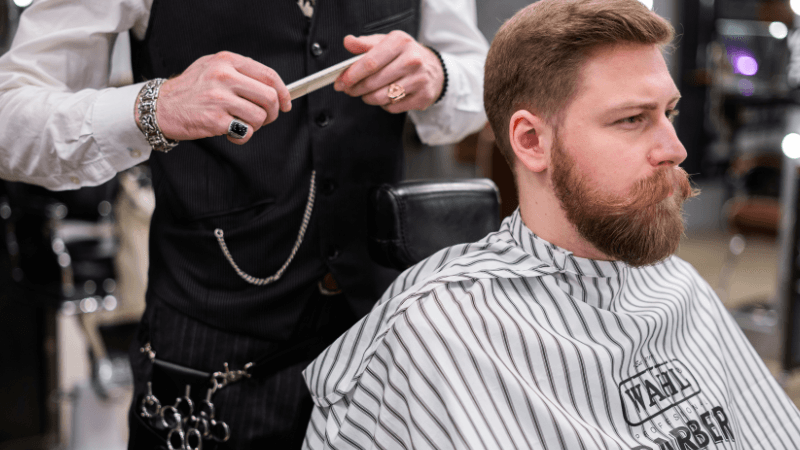
5 myths about men's haircuts that still prevent you from choosing the right one
Myths about men's haircuts outlive the trends themselves. A man hears the same advice from his father, a gym buddy, and the barber in the next chair—and at some point, he stops wondering where it came from. We examine five such beliefs: which ones actually influence the outcome of a haircut, and which ones can simply go unheeded.
Myth 1: Frequent haircuts speed up hair growth
What's really happening to your hair?
Hair growth begins in the follicle—it's located under the scalp, not at the ends, which the barber trims. Growth rate is determined by genetics and hormones, and the visible portion of the hair that is cut with scissors is made of keratin and is no longer directly connected to the follicle. Therefore, the answer to the question of whether a man's hair grows faster after a haircut is simple: no; the rate of growth doesn't change regardless of how often he visits the barber.
Why does growth seem to be accelerating?
The illusion is caused by split ends. While hair is long and damaged, it breaks off along its entire length and visually "stops growing." As soon as the barber removes the damaged area, the hair stops breaking and maintains its length—creating the impression that the haircut sped things up. In reality, it simply removed the impediment that was stealing the already-grown length.
Myth 2: Short hair requires no maintenance
This is one of the most convenient misconceptions—and the most short-lived. A short haircut requires less styling, but it doesn't eliminate maintenance altogether. Even at a minimal length, hair and scalp need the right shampoo, regular washing, and nourishment—otherwise, it becomes dry and the shape loses its definition more quickly. A short haircut requires no maintenance—this is a myth in the sense that it's easier to maintain, but not that it's completely eliminated.
Regularity of haircuts also plays a role here:
- the shorter the form,
- the faster the regrown temple or back of the head is noticeable,
and the more often you need to return to the barber so that the haircut does not look untidy.
Myth 3: All men's haircuts are the same
From the outside, all men's haircuts seem the same: short sides, buzz cut, and done. In reality, fades, undercuts, side-swept cuts, half-swept cuts, and crops differ not only in length but also in the flow between sections, hair texture, and how the shape flatters a specific face. Barbers select a style based on the client's face shape and hair texture, rather than applying a single template to everyone. The difference is especially noticeable when comparing a fade with a sharp outline and a soft transition in a side-swept cut—visually, they are two distinct styles, not one style under different names.
Two more myths you should stop believing
Whether clippers or scissors are better for a men's haircut is a question with no universal answer. Clippers create a clean, consistent line and are suitable for short haircuts, while scissors are ideal for those requiring texture and a smooth transition between lengths. A good barber combines both tools in a single cut rather than making a single, one-size-fits-all decision.
It's a similar story with styling: whether men need styling products is more a matter of habit than actual necessity. Gel, wax, and paste aren't essential for a short haircut, but they help maintain style longer between barber visits, especially if your hair tends to frizz or lose volume throughout the day.
Where to get a men's haircut in Odessa
It's helpful to debunk these myths before your barber appointment—it's easier to explain what you want and avoid wasting time on a style that doesn't suit your hair type. On Alvibeauty, you can browse men's haircuts in Odessa by stylist, reviews, and prices, and book directly with the salon that's right for you.
Frequently Asked Questions
Is it true that cutting your hair makes your hair grow faster?
No. The growth rate is determined in the follicle under the scalp and is not affected by how often you get your hair cut.
Do short men's haircuts require maintenance?
Yes, although to a lesser extent than for long hair: regular washing and timely correction of the shape remain mandatory.
Do all barbers cut hair the same way?
No, the haircut shape is selected based on the hair structure and face shape of a specific client, and not according to a single template.
What's better for a men's haircut: clippers or scissors?
It depends on the task: clippers create crisp lines on short hair, while scissors create texture and smooth transitions. Barbers often use both tools in the same cut.
Do men need styling products?
Not necessarily, but gel, wax, or paste can help your haircut hold its shape longer between barber visits.