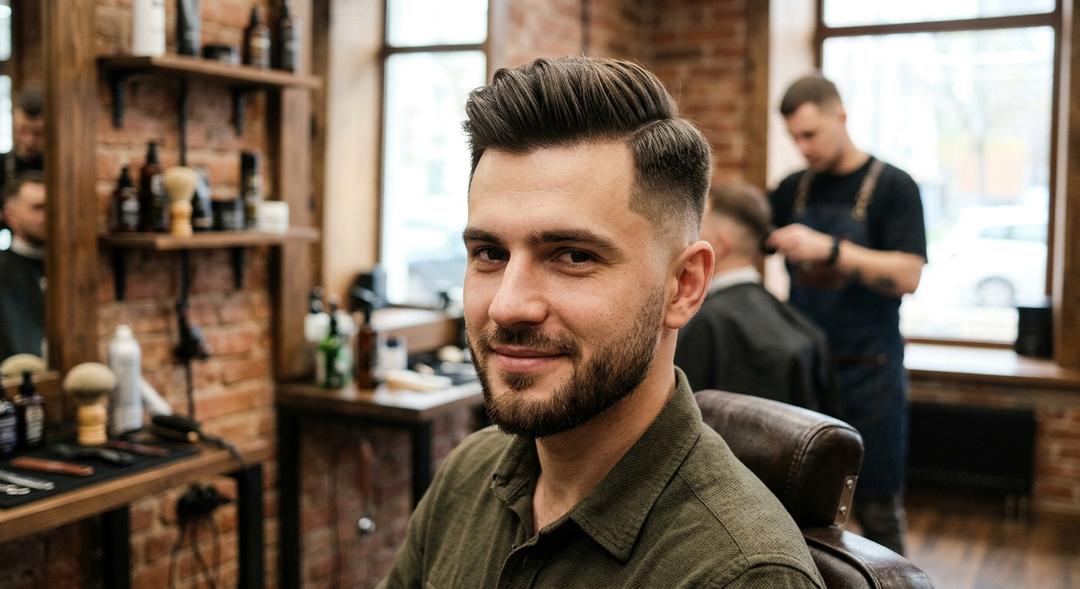
The Canadian Men's Haircut: A Universal Classic for Any Man
This haircut had a name long before it became one of the most recognizable men's hairstyles—and almost no one today remembers what it was originally. The men's Canadian haircut is a rare example of a transformative hairstyle: like a good jacket that's equally appropriate for a meeting or a party, it adapts to the occasion, not the other way around. If you're already looking at men's haircuts in Lviv from Alvi Beauty, the Canadian is almost certainly on your shortlist—and not just for men: women have a similarly named haircut, but that's a whole other story, unrelated to the men's Canadian we're discussing here.
Why is this haircut called the "Canadian"?
Most have heard the usual version: the haircut got its name from Canadian hockey players, whose neat, short backs and sides captivated Soviet spectators during the historic hockey Super Series of the 1970s. This version is correct, but incomplete. Long before hockey, a similar uniform existed in the navy—in the USSR, among Soviet sailors, it was called the "kanatka."
- the hair was cut straight,
- as if on a tightrope,
- hence the name.
The disciplined naval silhouette was simply waiting for its big name—and it got one when Canadian athletes accidentally showed the world the same idea from other stands. You don't need to know this to book a haircut, but it's nice—when the hairdresser specifies the length of your sideburns, you understand exactly where that proportion came from.
Who is the Canadian haircut suitable for?
Barbers agree on one thing: the Canadian cut is primarily about the balance between length and shape. A longer top and shorter sides truly work on almost any face shape and hair texture—even the most discerning barbers agree. The only differences are in the details: for an elongated face, a barber will leave a little more length on the sides, while for a square face, they'll add volume on top to soften the features. Fine hair finds it easier to hold its shape at a shorter length, while thick hair feels more comfortable with a longer cut. But here's the takeaway, which many only learn in the barber's chair:
- A Canadian woman is not chosen “to match a face type” using a template – she is adapted to a specific person,
- and that's why the same haircut looks different on different men,
- while remaining recognizable.
Types of Canadian haircuts
Classic Canadian
A smooth transition from short sides to a longer crown, a neat silhouette without harsh contrasts—a look equally appropriate for the office and an evening event. This is the style barbers typically recommend for those considering a new hairstyle.
Sports (modern) Canadian
A shorter length, minimal styling time, and a slightly more pronounced contrast between zones. What many simply call a "convenient option for an active lifestyle" is increasingly being done using a technique similar to a fade or taper—a smooth gradient without a clear boundary. Few clients even mention the word "Canadian" when choosing this cut from a photo—but essentially, it's the same thing, just with a more modern twist. Occasionally, you'll find rarer variations—a long Canadian with a fully grown-out top or a model version with side-swept bangs—but they all share the same principle of contrast between the length on top and the sides.
How to style and care for a Canadian
Here, the Canadian haircut for men truly lives up to its reputation for being low-maintenance: wash, blow-dry, and style—and for many, that's all there is to it. For a more pronounced result, a small amount of paste or medium-hold wax is sufficient. Three effective styling options allow you to switch up your look without a trip to the salon: slicked back—the quickest and most versatile option; side-swept—a little more formal, requiring a neat parting; and no styling—a subtle, natural tousle that suits many more than it first appears. A conclusion rarely voiced: the shorter the haircut, the more it resembles a T-shirt made of good fabric—the less you fuss with it, the better it fits, and overpaying for strong hold products for a few hours out of the house is usually unnecessary.
FAQ
Why is this haircut called Canadian?
The name stuck thanks to Canadian hockey players who popularized this uniform in the 1970s, although a similar silhouette—called the "rope"—was seen even earlier, among Soviet sailors.
What is the difference between a Canadian and an undercut?
In an undercut, the line between the short sides and the long top is usually sharp and contrasting, without a smooth transition. In a Canadian cut, on the other hand, the transition is smooth—and this softness is the main visual difference.
What is the difference between a Canadian and a British woman?
The key detail is that smooth transition at the sides and back. Remove it, and you'll get a sharper silhouette, commonly known as the British cut.
How often do I need to renew my Canadian passport?
On average, once every 3-5 weeks, depending on the rate of hair growth and how clearly you want to see the border between the zones.
Is it possible to make a Canadian yourself at home?
Basic styling—yes, no problem. But it's best to leave the actual haircut to a professional: too much depends on the precise angle of the cut and high-quality thinning, which is difficult to replicate in front of a mirror.