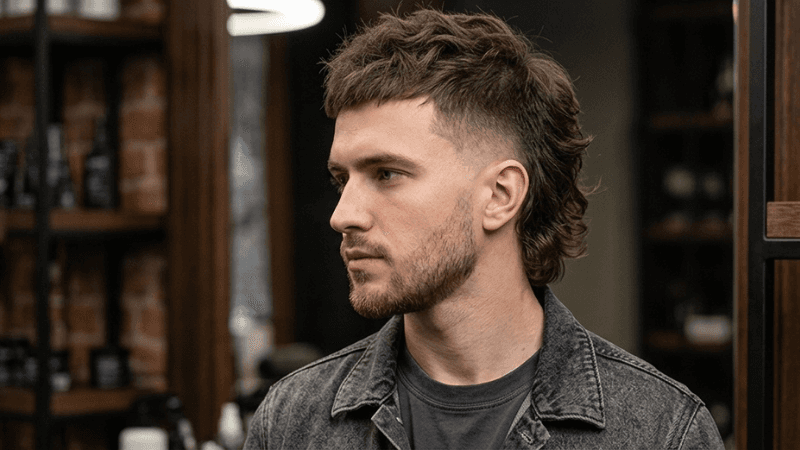
Men's mullet haircut: what it looks like and how to choose one
This style's reputation often outstrips its appeal: some remember the 1980s, others recent fashion shows and Korean dramas. In reality, a mullet haircut is all about the logic behind the shape, and only then about the style. If you're looking for a listing, the Men's Haircuts section on the AlviBeauty website ( https://alvibeauty.com/ru-ua/salons/kremenchuk/hairdressers/mensHaircuts ) in Kremenchuk allows you to discuss the look with a hairstylist in person. Here, we'll explore the mechanics: what makes up the shape and what you can adjust to suit your personal style.
What does a mullet haircut look like and what makes its shape recognizable?
The term "mullet" refers to the overall shape, but its exact appearance depends on the difference in length between the sections—easy to recognize even without a photo. The sides and sides are trimmed short, sometimes almost shaved in contrasting versions. The crown retains volume and texture, while the back is noticeably longer than the rest of the head. There's almost always a contrast in length between the sections, some sharp, others softened. The ear contour—with open ears and a clear line—can be sharp or softened with thinning. Search terms sometimes use the reversed wording, "mullet haircut," but in Russian, "mullet haircut" is more natural.
The jagged cut at the nape and textured strands on top enhance the sense of movement rather than geometry—the mullet here is closer to an oversized coat than a tailored suit. If you're looking for photos of a mullet haircut, pay attention to the length of the sides relative to the nape, the definition of the transition, and the cut—this way, the shape is recognizable in person.
What to consider in the form:
- temples and side areas;
- back of the head;
- bangs and contour around the ears.
What types of men's mullets are there?
Men's mullet haircuts differ not by a single feature, but by a combination of length and contrast—these are more like coordinates along two axes than competing options.
Modern and classic men's mullet
The classic version maintains a sharp line between short sides and a long back, without any gradual fades. The modern men's mullet often softens this line: a men's mullet with a fade adds a smooth taper at the sides, while thinning removes excess weight from the back. The choppy ends and textured crown serve the same purpose in both versions—the classic version simply achieves it more dramatically.
Short, long and Korean mullet
A short men's mullet reduces contrast by bringing the sections closer together. A long men's mullet enhances the contrast and allows for more freedom in styling the back of the head. The Korean men's mullet stands apart: it typically features a pronounced curtain fringe and gently graduated sides, and the contrast is usually lower than in the classic mullet.
Who suits the mullet haircut and what can be adjusted?
The principle here is slightly different than with the face shape list. The final look is influenced not so much by the face shape as by hair density, hair growth direction, and hair texture—the degree of contrast is adjusted to these parameters. It's similar to choosing eyeglass frames: the shape is the same, but the fit on a specific face determines whether the result will look natural.
If your hair is thick, you can soften the contrast between the zones. With fine hair, a slightly more defined line often helps maintain the shape, and the direction of hair growth at the back of the head determines how evenly the length will fall without styling.
What parameters can be changed:
- length of the temples;
- the severity of the transition between zones;
- the shape of the bangs;
- the length of the back of the head.
How to choose the length of the back of the head, temples, and bangs
There's no single required length for a mullet—there's a range within which the shape can still be considered a mullet. The appropriate length for a mullet depends on the contrast you're willing to wear: the shorter the sides, the more noticeable the contrast with the back, even if the back itself isn't grown out very much.
A men's mullet with bangs adds another dimension. Short bangs leave the contrast between the temples and the nape of the neck as the main element of the shape. Long bangs or curtain bangs soften the silhouette and make the transition less obvious. There's no mandatory option—the choice depends on which part of the look you want to emphasize.
How a mullet works on straight, wavy, and curly hair
It's not the shape itself that changes hair type, but how it reads after styling, and no one type works worse here than another.
A mullet on straight hair reveals the cut line as honestly as possible: asymmetry in length is immediately noticeable, and a neat cut is especially important for this style. Waves work in the opposite direction: a mullet on wavy hair softens the transition almost on its own, blurring the lines between the zones.
The shape changes most significantly on curls: after drying, the length visually shortens, and a mullet on curly hair rarely does without careful thinning.
How to style a mullet and when styling is optional
Whether or not a mullet should be styled is more a question of desired effect than necessity. If the cut is done with the hair's growth in mind, the shape can be maintained by the natural texture—especially on wavy and curly hair, where the crown already has volume.
How to style a mullet for a more put-together look: A lightweight, matte-textured product on towel-dried hair is usually sufficient, without a tight hold that will make transitions between sections difficult. For wavy and curly hair, a diffuser can be used instead of air-drying. This style doesn't require a special set of products—the quality of the haircut is more important than the amount of products on your head.
What's the difference between a mullet, a shag, and a cascade?
The mullet relies on a distinct division of zones: short sides and a longer back, with a demarcation between them almost always present, even if softened. The shaggy is constructed differently—the layers and texture are distributed more evenly, without a pronounced contrast between the back and the rest of the head. The cascade is a gradual change in length from the crown to the ends, without a sharp transition between zones.
Frequently Asked Questions
How to get a mullet haircut?
The easiest way to get a mullet haircut is to discuss the degree of contrast and the shape of the bangs with your stylist in advance—this will determine the length of the back of the head and how short the sides are cut.
What kind of hair is a mullet suitable for?
The shape can be adapted to any hair structure: straight, wavy, and curly hair show the transition between zones differently and require different degrees of thinning.
What hair length is needed for a men's mullet?
There is no strict minimum: what is more important is not the absolute length, but the difference between the temples and the back of the head, which can be achieved on both medium and longer hair.
Is it possible to get a mullet without a noticeable long tail?
Yes, the short men's mullet is built on a moderate difference in length: the back of the head is noticeably longer than the temples, but without a very elongated silhouette.
How often does a man's mullet need to be adjusted?
The frequency depends on the rate of hair growth and the chosen degree of contrast: the shorter the temples, the faster the border growth is noticeable.