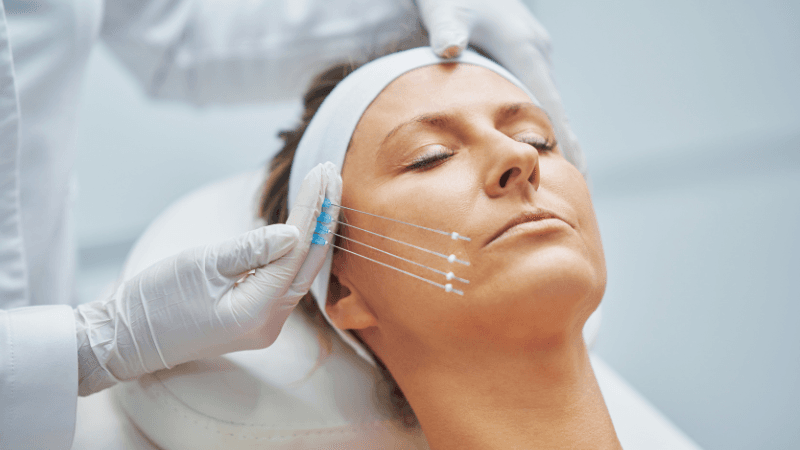
Thread Facelift: Myths, Risks, and Real Results
If you're increasingly considering a facelift, but the idea of surgery is daunting and age-related changes aren't yet severe enough to warrant surgery, thread lifting may be an option. Thread lifting allows you to reshape your face without surgical incisions, but the procedure has limitations and isn't suitable for everyone.
Let's take a closer look at how the method works, what results to expect, and what's important to know before the procedure. You can find the right cosmetology service and location for the procedure in the cosmetology section in Kharkiv .
Thread lifting: what it is and how it works
What is thread lifting? Briefly, it's a minimally invasive procedure in which special threads are inserted under the skin. Depending on the type of thread, this method can be used for tissue stabilization, facial contouring, or skin reinforcement.
Mechanical fixation of tissues
The barbed threads are anchored in the tissue and hold it in its new position. Initial changes may be noticeable immediately after the procedure, but the final result should be assessed after swelling has subsided and the initial recovery period has completed.
Formation of a collagen framework
After the thread is inserted, connective tissue gradually forms around it. This process can maintain the achieved effect even after partial or complete absorption of the material.
Insertion of threads through micro punctures
The doctor inserts the threads using a needle or cannula through small punctures. Incisions and sutures are usually not required. The procedure is usually performed under local anesthesia.
Thread lifting encompasses several methods. Their effectiveness depends on the material, shape, and placement method of the threads.
Types of threads: how they differ
Different types of threads are used for thread lifting. The choice determines the severity of the correction, the duration of the results, and the recovery process.
Mesothreads: smooth and spiral
These threads are used primarily for tissue reinforcement. They do not provide significant mechanical lifting and are generally considered for minor age-related changes.
Threads with notches
The notches help hold the tissue in place. These threads are used to correct facial contours or specific areas. Aptos and Happy Lift are examples of brands, but a doctor should select the specific system after a medical examination.
Gold and platinum threads
This is a separate group of non-absorbable sutures. They are used less frequently, and the presence of precious metal does not necessarily mean the results will be more pronounced or last longer.
Who is thread lifting suitable for?
The procedure may be considered for cases of initial or moderate tissue sagging, loss of facial contour, and localized age-related changes. Indications can only be determined during an in-person examination.
Age alone is not the primary criterion. The doctor evaluates the density and condition of the skin, the severity of ptosis, the volume of soft tissue, and the expected result.
Contraindications to the procedure
Thread lifting may be contraindicated in the following conditions:
- blood clotting disorders;
- taking medications that affect coagulation;
- inflammation or infection in the intended injection area;
- tendency to form keloid scars;
- pregnancy and breastfeeding;
- some autoimmune and oncological diseases.
The final decision will be made by the doctor after collecting the patient's medical history. You should not stop taking anticoagulants or other prescribed medications on your own before the procedure.
Age restrictions
There's no strict universal age for thread placement. At 20–25 years of age, the procedure is usually unnecessary unless there are objective indications. In older age, the result depends not on age but on the severity of the changes and the condition of the tissue.
If there is significant excess skin, threads may not provide the desired lift. In this situation, the doctor may suggest an alternative correction method or a consultation with a plastic surgeon.
How does the procedure work?
First, the doctor conducts an examination, determines any medical conditions and medications being taken, and assesses the tissue condition. Afterward, the type of thread, the injection pattern, and the treatment area are selected.
- Preparation and consultation
An in-person consultation is necessary because a photograph cannot accurately determine skin density, the degree of ptosis, and the appropriate thread placement depth. Before the procedure, the doctor should explain the limitations, possible complications, and recovery guidelines.
- Insertion of threads
After cleansing the skin, marking it, and administering local anesthesia, the doctor inserts threads through small punctures. The duration of the procedure depends on the area and the number of threads used. It usually takes about 30–60 minutes.
- Rehabilitation
Swelling, bruising, soreness, a feeling of tightness, and temporary unevenness of the skin are possible during the first few days. Your doctor may recommend limiting exercise, facial massage, sauna use, and other activities during the recovery period.
Timeframes and restrictions vary, so you should follow your doctor's personal recommendations rather than universal instructions from the internet.
How long does the effect last?
The exact time frame cannot be determined in advance. It depends on the type of threads, the placement technique, the condition of the tissue, age, lifestyle, and facial expressions.
After the placement of absorbable mesothreads, the results can last for several months. They provide primarily a reinforcing effect and are not intended for significant tissue tightening.
Threads with barbs may provide a longer-lasting effect. However, it's impossible to promise a specific time frame without an examination. Natural age-related changes continue, even if connective tissue has formed around the threads.
Results may vary between two patients with the same threads. This is influenced by the initial tissue condition, changes in body weight, habits, facial expressions, and adherence to recovery recommendations.
Myths about thread lifting
There are both exaggerated fears and inflated expectations surrounding the procedure.
Before recording, it is important to separate the specifics of the method from the advertising promises:
- Thread lifting is sometimes considered a very traumatic procedure. In fact, it's considered a minimally invasive method, requiring no surgical incisions. However, the insertion of threads still causes tissue damage, so swelling, bruising, and soreness are possible after the procedure.
- Another myth concerns the need for general anesthesia. In most cases, local anesthesia is used.
- Other types of anesthesia may be required depending on the extent of the procedure and medical indications.
Concerns about inevitable scarring are also exaggerated. After thread insertion, small punctures remain, which usually heal without noticeable marks. However, the risk of prolonged healing or scarring cannot be completely eliminated.
Risks and possible complications
What are the risks of thread lifting? In addition to the expected swelling, bruising, and discomfort, complications are possible after the procedure, requiring a doctor's examination.
Asymmetry may occur due to uneven tension, improper placement, or displacement of the threads. A slight difference in the first few days is sometimes due to swelling, but this should be assessed by a doctor.
Increasing pain, severe redness, increased temperature, and discharge from the puncture site may indicate inflammation or infection. If these symptoms occur, consult a doctor.
If the thread is placed too superficially, it may become visible under the skin. In some cases, adjustments to its position or removal of the material may be necessary.
Minor bruising and swelling are common temporary side effects. Their severity and duration depend on the individual's individual characteristics and the extent of the procedure.
Thread lifting or SMAS lifting
These are different methods and cannot be considered direct substitutes for each other. Threads mechanically fix the tissue, while hardware-based SMAS lifting targets deeper layers using focused ultrasound.
The thread method can be used for localized correction and tissue fixation in cases of mild to moderate ptosis. Initial changes after thread insertion are usually noticeable sooner than the results of an ultrasound procedure.
Hardware-based SMAS lifting can be offered to patients who don't require mechanical tissue movement. Results develop gradually and depend on the equipment used, the parameters of the procedure, and the initial condition of the skin.
The choice of method is made after an in-person examination. The doctor takes into account the severity of the changes, tissue thickness, contraindications, and the expected result. If there is significant excess skin, none of these methods can always replace a surgical lift.
Exosome therapy as an additional method
Exosomal preparations are used in cosmetology to support regenerative processes. These procedures do not provide mechanical tightening and do not replace thread lifting.
Exosomes are extracellular vesicles involved in signaling between cells. The feasibility and safety of the procedure depend on the composition of the drug, its administration method, and the available evidence base.
Biorevitalization typically involves the administration of hyaluronic acid-based products. Exosomal products have a different mechanism of action, so comparing methods solely on the basis of "which is better" is inappropriate.
The need for exosome treatments or other additional procedures after thread placement is determined by the doctor. The sequence and intervals are determined based on tissue recovery. Combining multiple procedures into a single session is not recommended.
Frequently Asked Questions
How long does the effect of thread lifting last?
The duration of results depends on the type of threads, the condition of the tissue, and the insertion technique. It's impossible to give an exact time frame without an examination. Mesothreads generally provide a gentler and shorter-lasting effect than barbed threads.
What are the possible consequences and complications?
Expected temporary reactions include swelling, bruising, soreness, and a feeling of tension. Potential complications include inflammation, asymmetry, contouring, thread displacement, or thread extrusion.
Who should not undergo thread lifting?
The procedure may be contraindicated in cases of bleeding disorders, inflammation in the treatment area, pregnancy, breastfeeding, and certain systemic diseases. A complete list of contraindications will be determined by the physician after reviewing the patient's medical history.
Which is better: thread lifting or SMAS lifting?
These methods address different issues. Threads mechanically fix tissue, while ultrasonic SMAS lifting targets deeper layers without introducing material. The choice depends on the tissue condition and the desired degree of correction.
How many times can threads be applied to the face?
There is no set number of procedures. The possibility of repeat implantation depends on the tissue condition, the results of the previous procedure, the type of threads used, and the presence of complications.