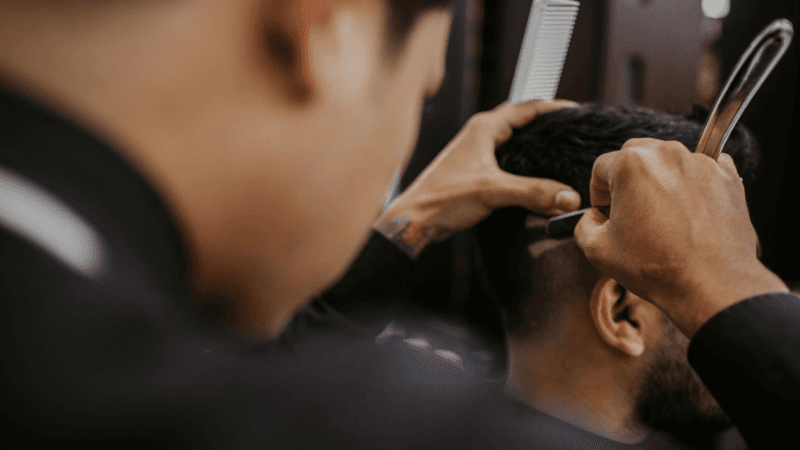
What haircut visually adds thickness to thin hair?
Thin hair isn't a death sentence for men, but not every haircut works. The right cut can change how thickness is perceived even before you start styling.
Why does fine hair look thinner than it actually is?
A haircut for men with fine hair solves a specific problem: it doesn't physically add hair, but rather changes the length contrast to make the top appear fuller. It's not the number of hairs that matters, but the diameter of each hair—fine hair physically doesn't hold weight and shape as well as coarse, dense hair. This results in what many mistake for a lack of thickness: the hair simply lies flat under its own weight, making the scalp appear more noticeable than it actually is.
3 working haircut scenarios depending on the problem
There's no universal answer to the question of which haircut makes fine hair thicker —the haircut is chosen based on what's happening to your hair:
The hair is thin all over the head.
If the hair is evenly thinned and without noticeable bald spots, a contrast in length works: short sides and back, slightly longer crown. Crop, half-bobbed, and Caesar cuts are all suitable—a short base prevents the hair from falling under its own weight, and the difference in length between the zones creates optical volume at the top.
The hair is just thin, but without bald spots.
The goal here isn't to lift the hair, but to eliminate the "translucent" skin between the strands. Thinning the ends and lightly grading the hair helps—it distributes the strands unevenly, making the gaps between them less noticeable than with a straight cut.
Hair is thin and quickly loses its shape during the day.
If your haircut looks fine in the morning but flattens out by evening, it's not the cut itself that's at fault, but the combination of length and styling. Here, the short length works in tandem with the volume at the roots from styling—without this, even the most perfectly shaped haircut will flatten within a few hours.
What does a barber do technically to add thickness?
The mechanics are similar in all three cases. Essentially, a men's haircut for visual volume relies on two factors: the cut point and the contrast in length. A tight, even cut at the ends visually thickens the hair, while thinning creates a lighter appearance, but requires precision, otherwise the hair begins to look even thinner. The contrast between the short sides and the longer crown is an optical trick that works regardless of the actual hair thickness: the eye perceives the difference in length as volume. Barbers also lift the hair at the root with a blow-dryer, against the direction of hair growth. This isn't a fashion statement, but rather a sign that the lifted root physically creates visible root volume, which lasts longer than simply styled hair.
Mistakes that make hair look even thinner
Part of the problem is created by the person himself, even with a good haircut:
- Long side strands are the most common mistake: if the sides are not shorter than the crown, there is no contrast, and the entire haircut looks like one flat mass.
- A glossy, wet-look gel glues strands together into distinct, bold lines, with the scalp clearly visible between them—for fine hair, this works against volume, not for it.
- A sharp, straight parting on fine hair exposes the scalp in a smooth strip; a light side parting or a comb-over without a sharp line works better.
- Trying to grow thin hair longer to “cover up” the problem usually has the opposite effect—the longer the thin hair, the more noticeable its thinness becomes.
Where to get a men's haircut in Odessa
If you previously chose a haircut by eye and the result lasted only until your first wash, it's smarter to discuss with your stylist which of the three scenarios best suits your situation. Men's haircuts in Odessa can be found among stylists and barbershops specializing in this type of haircut—from a subtle thinning to a full-on crop with contrasting lengths.
Frequently Asked Questions
What is the best haircut for adding volume to fine hair?
Short haircuts with a clear contrast in length on the sides and crown—cropped, half-bobbed, and Caesar cuts—are available. The length is cut so that the ends hold their shape rather than drooping under their own weight.
Is it possible to grow thin hair to make it look thicker?
In practice, the opposite effect occurs: the longer fine hair, the more noticeable its thinning becomes, as the strands lose weight and fall out. Shorter hair lengths usually appear thicker.
What styling products don't weigh down fine hair?
Lightweight: matte paste, volumizing powder, texturizing spray. Heavy gels and waxes with strong hold stick together strands and expose the scalp.
How often should you get a haircut if you have thin hair?
Once every 3-5 weeks - this way the shape does not have time to grow and lose the clarity of contrast on which the effect of density is based.
Can a haircut visually soften a receding hairline?
A haircut doesn't eliminate bald spots or address their cause, but a short length with even contrast makes the transition between skin and hair less noticeable.