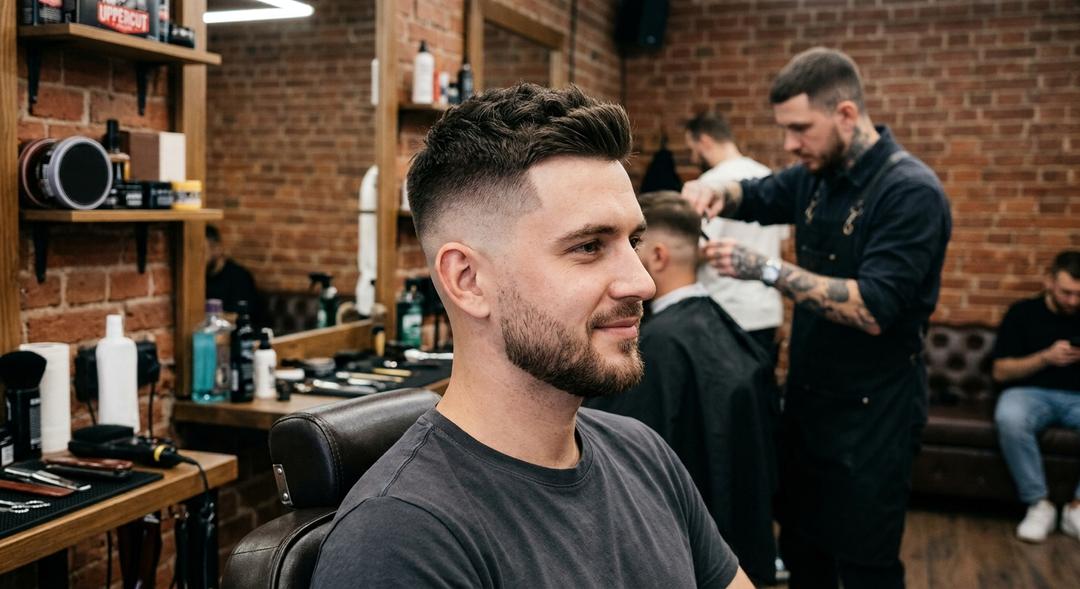
Fade Haircuts for Men: Types and How to Choose
If you've been told "let's do a fade" at the barbershop or hair salon and nodded along, not really understanding what they were talking about, this article is for you, whether you're the one sitting in the chair or the one choosing a haircut for your man. A men's fade haircut isn't just "shorter on the sides": it's a technique where the hair tapers from the back to the crown without a sharp line. Understanding the different types is easy, and finding your perfect look at AlviBeauty is even easier if you know what to look for on the website https://alvibeauty.com/ru-ua/salons/lviv/hairdressers/mensHaircuts .
What is a Fade—and Why It's More Than Just "Shorter on the Sides"
Most people know a fade simply as a "cut with a transition": short at the neck, longer at the crown. That's true, but it only explains half the story. A fade (from the English "fade" meaning "to disappear") isn't a separate haircut, but a technique for working the sides and back of the head that a barber can apply to almost any men's hairstyle, from a crop to a classic.
The smooth transition here works like dawn: there's no formal boundary between night and day, but at some point it's already light, and the hair changes length imperceptibly, without steps or creases. Incidentally, if a barbershop lists both a fade cut and a fade haircut , don't be alarmed—they're the same technique, just worded differently in the service description.
Few people realize that a "fade haircut" and a "men's fade haircut" are actually the same thing; the only difference is how you formulate your request to the barber.
Five Faces of the Fade Technique – Let's Break Down the Types
All fade types differ in one thing: where the transition begins and how abruptly it is defined. If you think of it like a volume scale at a party, a low fade is a quiet background, a medium fade is a comfortable volume for conversation, and a high fade is full bass. Technically, the transition is created by shading—a smooth, machine-smooth blending without sharp steps, which makes the transition line appear more smoky than defined. There are five variations of this technique:
- low fade - transition almost at the neck;
- middle fade - the transition begins above the ears;
- high fade - the transition at the temples, the most contrasting;
- extended fade (taper fade) - a stretched transition without a sharp point;
- Fade with scissors - without a machine, the softest in contrast.
Below are more details on each type.
Low Fade
The fade starts almost at the neck, leaving most of the head relatively long. It's the most understated and versatile option—suitable for both business looks and those who aren't ready for dramatic contrasts. Less well known is that a low fade exposes the least amount of scalp, making it more forgiving of minor irregularities in the scalp than its higher counterparts.
Middle Fade
The fade begins roughly above the ears—hence its other name, the classic fade: this is how military men have been cutting their hair for decades. It looks great in both the office and the gym. Less obvious: the mid-length fade requires less styling products than you might think—the shape holds almost naturally, without any styling.
High Fade
The contrast here is most noticeable: the length on top versus the almost bare skin on the sides. When the fade reaches all the way to the scalp, this extreme case is called a skin fade. A bold choice for those who aren't afraid of attention. Few people specify the style beforehand, but a high fade is especially demanding of the scalp shape and tone—the barber evaluates this before, not after, picking up the clippers.
Extended Fade
The transition here is extended along the entire length, without a sharp point of disappearance—hence the English name "taper fade." The haircut blends softly with a beard and a slightly longer top. Few people know: an extended fade is closest in feel to an undercut, but without its sharp edge at the temples.
Fade with scissors
A clipper-less, no-cut option—the transition is created solely with scissors, making it softer and less contrasting. It's perfect for those who want a fade but aren't ready for the rigor of a barbershop look. Be aware: this technique requires a more experienced stylist than the classic clipper fade, as it's harder to correct a mistake with scissors.
How to keep your fade looking fresh—and when it's time to go to the barber
Everyone knows that a short haircut holds its shape longer than a long one—and this applies to fades too. On average, a neat look lasts 2-3 weeks after a fade. What's less obvious is that it's the fade line, not the top length, that fades the fastest—the line begins to blur by the end of the second week, even if the hair hasn't visibly grown out much. To keep your fade looking fresh:
- Use a light styling paste or clay rather than gel—gel creates a “wet” effect that quickly makes your hair look dull;
- pay attention to the transition line, and not to the length at the top - it “goes away” first;
- Visit your barber once every 3-4 weeks—regularity keeps your hair in shape better than rare, radical corrections.
It's this regularity, not the intensity of the cut, that determines how long a fade haircut will keep you looking like you just left the barbershop.
Frequently asked questions about the fade haircut
What is the difference between a fade and a crop?
A crop is a haircut with a specific shape and texture on top, while a fade is a technique for treating the sides and back. They're not an either-or choice: a crop on top pairs beautifully with a fade on the sides; they're more of a duet than a competition.
What is the difference between a fade and a half-box?
A half-bob is a specific length and shape of the haircut, while a fade is the transition between lengths. A half-bob can be created with either a fade or a sharper edge; a fade simply softens the transition.
Who is a fade suitable for – based on hair type and face shape?
Fade looks equally good on straight, wavy, and curly hair—only the degree of contrast varies. There are no strict contraindications for face shape, but barbers typically recommend less contrasting styles for those who want to soften sharp features rather than emphasize them.
How long does a fade last and when should I update my haircut?
A fade haircut lasts on average 2-3 weeks, but the transition line fades first. The optimal interval for visits is every 3-4 weeks if you want the shape to remain defined rather than blurry.
Is it possible to do a fade with just scissors, without a clipper?
Yes, this is a separate type—the scissor fade, which we've already discussed above. The transition is softer and less pronounced than with a machine, so this option is chosen by those who want a fade effect without a strictly defined line.