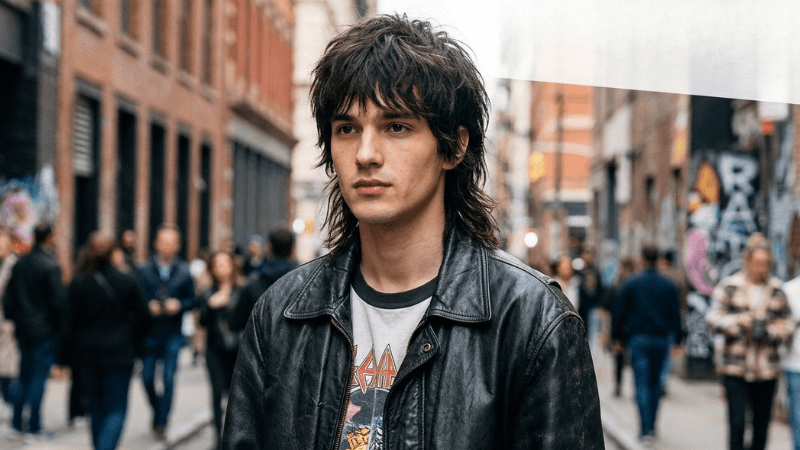
Wolf Cut: What It Looks Like and Who It Suits
The Wolf Cut is a layered style with noticeable texture, volume on top, and longer strands in the back. It's less formal than classic short haircuts: the hair can hang loosely around the face, with individual strands remaining free-flowing. See more men's haircuts at AlviBeauty:https://alvibeauty.com/ru-ua/salons/poltava/hairdressers/mensHaircuts
The name "Wolf Cut" is often found alongside "Mullet," but they are not the same haircut. The Wolf Cut typically has softer transitions between lengths, and the layers are distributed throughout the entire shape. Therefore, before visiting a hairstylist, it's best to look not only at the name but also at photos of the specific result you're hoping to achieve.
What is a Men's Wolf Cut?
The men's Wolf Cut is built around a combination of layers of varying lengths. The top is given more texture and volume, while the hair at the back is left longer. Depending on the style, the difference between the zones can be subtle or quite pronounced.
There's no set length for this haircut. The Wolf Cut can be adapted to short, medium, and longer hair. The shape itself also varies: one version looks softer, while another approaches a mullet with a noticeably longer nape.
Bangs are also optional. They can be short and textured, left long, parted to the sides, or blended into the side strands.
Who is the Wolf Cut suitable for?
When choosing a men's wolf cut, it's best to consider your hair structure and how it lies without styling. Wavy hair often naturally shows layers and texture. Straight hair sometimes requires additional styling, especially if you want pronounced volume on top.
Density also affects the result. On thick hair, a stylist can remove some volume and distribute the mass into layers. On thinner hair, it's important not to thin too much, to avoid creating sparse sections.
Before choosing a form, it is worth considering:
- hair length and thickness;
- straight, wavy or curly texture;
- direction of natural hair growth;
- the desired length of the back of the head and front strands;
- How much time are you willing to spend on daily styling?
Therefore, it's best to decide whether the Wolf Cut is right for you based on more than just your face shape. Hair texture and your usual styling can have a greater impact on the final result than the model's name alone.
Wolf Cut for short, medium and long hair
On short hair, the Wolf Cut is more compact. The top remains textured, the back is slightly longer, but the contrast between the sections is usually subtle. This option is suitable for those who want to maintain the characteristics of the Wolf Cut without significantly increasing the overall length.
Medium-length hair is more layered. You can leave the crown voluminous, the side strands extended, and the back longer. This length allows you to vary the direction of the front strands and the parting.
The long wolf cut looks softer due to the increased amount of hair. The transitions between layers are smoother, and the result is more dependent on the natural movement of the strands. It's especially important to decide in advance how much length to leave in the back.
How is Wolf Cut different from Mullet?
The Wolf Cut and Mullet are indeed similar. In both cases, the hair at the back can be longer than the top and sides.
The Mullet is typically characterized by a pronounced contrast between the relatively short hair at the front and sides and the long back. The Wolf Cut emphasizes layers, texture, and gradual transitions.
The line between these styles isn't always strict. Modern variations can combine features of both cuts. Therefore, the name a person gives to a hairstylist doesn't necessarily define the exact shape.
Wolf Cut for straight, wavy and curly hair
On straight hair, individual layers are usually quite clearly visible. If your hair is heavy and quickly loses volume, the crown may require additional styling after washing.
Wavy hair provides natural texture and movement, making the transitions between layers visible even without complex styling.
The Wolf Cut is also possible on curly hair, but you need to consider the degree of curl and the change in length after drying. The same haircut on straight and very curly hair will produce different results.
What bangs go with the Wolf Cut?
There's no single fringe option for the men's Wolf Cut. Its shape depends on the length of the front strands, the hair texture, and how the person wears it.
Short, textured bangs further accentuate the layers in the front. The longer strands can be swept across the forehead, to the side, or parted. A longer wolf cut can be paired with curtains, with the front strands parted to the side.
If your hair consistently grows in a certain direction, it's best to take this into account when choosing a style. Changing your natural growth direction on a daily basis is usually more difficult than adapting your haircut to it.
How to Style a Men's Wolf Cut
The difficulty of styling depends on the length and texture of your hair. If your hair naturally retains its texture, after washing, it may be enough to simply blow-dry it in the desired direction and then use your hands to distribute the strands.
For more pronounced volume, lift the top section at the roots while drying. It's not necessary to smooth all the layers completely: one of the hallmarks of the Wolf Cut is the noticeable movement of the hair.
If you're looking for a haircut that doesn't require extensive daily styling, it's worth discussing this with your stylist in advance. This way, the shape can be tailored closer to the natural hair fall, rather than a look that requires careful styling to achieve the desired result.
What to show the hairdresser before a haircut
The phrase "I want a wolf cut" can mean a variety of things. Photos of the same name feature both soft, layered shapes and styles with a pronounced elongation at the nape.
Before cutting, it is useful to:
- save 2-3 photos with a suitable shape;
- Show the desired length of the back of the head separately;
- determine the length and direction of the bangs;
- say whether you need pronounced volume on the crown;
- Explain how noticeable the difference should be between the top and back of the head.
This way, the hairdresser gets guidance not only by the name, but also by the specific details of the future haircut.
Frequently Asked Questions
What is a Wolf Cut for Men?
This is a layered cut with a textured top and longer hair at the back. The length, number of layers, and contrast between sections may vary.
Are Wolf Cut and Mullet the same thing?
No. The mullet is typically characterized by a more pronounced contrast between the short sections and the long back. The wolf cut is built primarily on layers, texture, and a more gradual distribution of length.
Is it possible to do a wolf cut on short hair?
Yes. The short version retains the layered top and a slight length at the back, but the difference between the zones is less pronounced.
Is Wolf Cut suitable for straight hair?
Yes. Layers are clearly visible on straight hair. If your hair lacks natural volume, you may need to style it to maintain the shape on top.
Can you do a wolf cut on wavy hair?
Yes, the waves naturally highlight the texture and movement of the individual layers.
Is it necessary to have bangs?
No. The wolf cut for men can have short or long bangs, with parted front strands or no bangs.