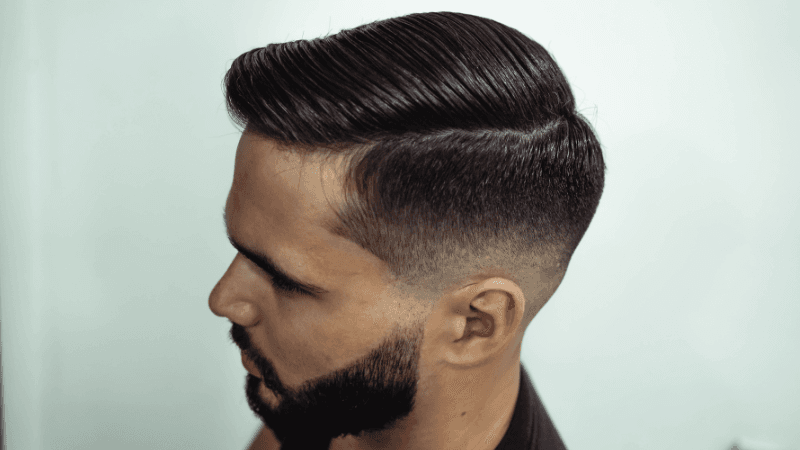
Men's Undercut Haircut: Bold in Look, Easy to Maintain
The undercut haircut is instantly recognizable—where other hairstyles taper off gently, here the sides are abruptly cut, as if by a ruler. For some, it looks too bold, for others, it's just what the classic style was missing. If you're already eyeing an undercut for yourself or a man, let's figure out together who it really suits and how to maintain it without turning your mornings into a ritual.
Undercut: What is this haircut and why is it chosen?
Essentially, the men's undercut haircut relies on one key principle: the hair on top remains long, while the sides and back are cut almost to nothing—without a smooth transition. The separation of the zones is as fundamental as the contrast in hair length overall. This is the sharp transition that's noticeable even from a distance.
Few people know that the current fashion trend has a nearly century-long history: the hairstyle was already worn by preppy students and hipsters in the mid-20th century, and barbers still sometimes call the short version with shaved sides the military style, in honor of the soldiers for whom this length did not interfere with wearing a helmet.
Who suits an undercut, and who should consider a different option?
The undercut is most often suited to men with straight or slightly wavy, medium-coarse hair and oval or square faces: the crisp edge visually elongates and balances the features. On fine, light hair, the contrast in length is less striking.
This doesn't mean that the undercut doesn't suit curly hair—professionals disagree on this point:
- Someone advises to cut the top shorter,
- someone, on the contrary,
- leave the length,
- so that the curls don't stick out.
It's like choosing heels to match a dress: there's no one-size-fits-all answer, just what suits your figure—and it's best to ask your stylist for advice rather than guess.
Types of Undercut: Three Characters of One Haircut
The undercut isn't just one haircut, but three in one idea: the difference between the options isn't in the technique itself (the sides and back of the head are almost completely cut off), but in the length of the top and the sharpness of the transition.
One barber or hairdresser will make an undercut discreet, another will make it almost flamboyant, and both will be right. Few people notice, but the shorter the top, the less room for error the stylist has—on longer versions, imperfections are easier to hide under the hair's own weight.
Short - businesslike and strict
The short undercut is the classic undercut once sported by both clerks and military personnel: minimal length on top, with a crisp edge on the sides. It doesn't require extensive styling and is the first thing that comes to mind when people think of the undercut haircut for men who want to look put-together from morning to night. Few people realize it, but the short version is the easiest way to disguise a receding hairline at the temples—the length on top draws attention where it needs to.
Long - with a claim to audacity
An extended undercut leaves 8-10 cm or more on top—enough to style a tousled top with shaved sides or, conversely, smooth it down. The difference from a classic undercut is patience:
- The longer the top, the more often you will have to reach for the hair dryer.
- Not everyone knows that historically the long version appeared first.
- Short versions came later, as a practical military response.
Cut off - no compromise
The undercut (or disconnection, in barber parlance) is the most abrupt of all: the transition isn't just short, but ends in a single line without a single millimeter of smoothness. The tricky part is that the more defined this line is, the more quickly the growing-out edge becomes visible, so it's best to shorten your barber visits rather than spread them out.
How to style an undercut: back or sideways
How to style an undercut is a matter of hair growth angle, not personal taste: most men's hair naturally falls to one side, and it's easier to adjust to that angle than to fight it every morning. A less obvious point: the barber will see this during the cut and will be honest if the natural hair growth doesn't align with the desired style.
Combed back
A slicked-back hairstyle is the most versatile way to style an undercut: it pairs well with both a shirt and a T-shirt. A medium-hold gel or paste on slightly damp hair is all you need. Many are surprised, but this style isn't about severity, but about saving time: on straight, manageable hair, it lasts all day without any curling.
Side-swept
A side-swept top looks softer and slightly more casual—for those who don't want to look too done up. Texturizing cream works better here than gel. A less obvious barber tip: keep the parting slightly wavy rather than perfectly straight—this will make the style look more natural and less "flowy" by evening.
Undercut Care: Minimal Effort, Maximum Effect
Maintaining an undercut haircut revolves around two key elements: a trim every 3-4 weeks at the barber's and the right styling products—wax for definition on the short version and paste for light texture on the longer version. Styling an undercut every day is a matter of two minutes in the morning, not a long fuss in front of the mirror.
The haircut is often combined with a beard (the undercut with a beard has long been a barbershop classic), with a fade (the undercut with a fade softens the line at the temples), and even with bangs (the undercut with bangs leaves a little more length in the front). A little-known fact: it's the frequency of visits to the barber, not the technique itself, that determines whether a hairstyle will look like a truly iconic haircut or simply unkempt.
Undercut or crop – what's the difference?
Barbers explain the difference between an undercut and a crop with one phrase: a crop has a soft transition and an even texture throughout the head, while an undercut has a sharp, almost graphic contrast between the temples and the crown. It's like the difference between watercolor and graphic art: in one case, the colors flow into each other, while in the other, there's a clear, almost hard line. If you're unsure what you're seeing in the barbershop mirror, look at that transition—whether it's smooth or abrupt—and the question will be answered.
Answering frequently asked questions
Who suits an undercut, and who should consider a different haircut?
It looks best on straight or wavy, medium-thick hair and an oval or square face shape. On fine, light hair, the contrast is less noticeable, but this is a matter of taste, not a hard and fast rule.
What's the difference between an undercut and a crop—and how can you tell them apart?
Look at the transition: with a crop it’s smooth and the texture is even across the entire head, while with an undercut it’s sharp, with shaved temples and a noticeably longer top.
How long does an undercut last and when is it time to go back to the barber?
On average, 3-4 weeks, after which the edging loses its definition, which is the whole point of the haircut.
How to style an undercut without looking disheveled?
Use gel or paste for a crisp backcombing, or texturizing cream for a more relaxed side-swept look.
Is an undercut suitable for curly hair?
Yes, but it's best to discuss the top length and styling method with your stylist—barbers have different opinions here, and there's no universal recipe.