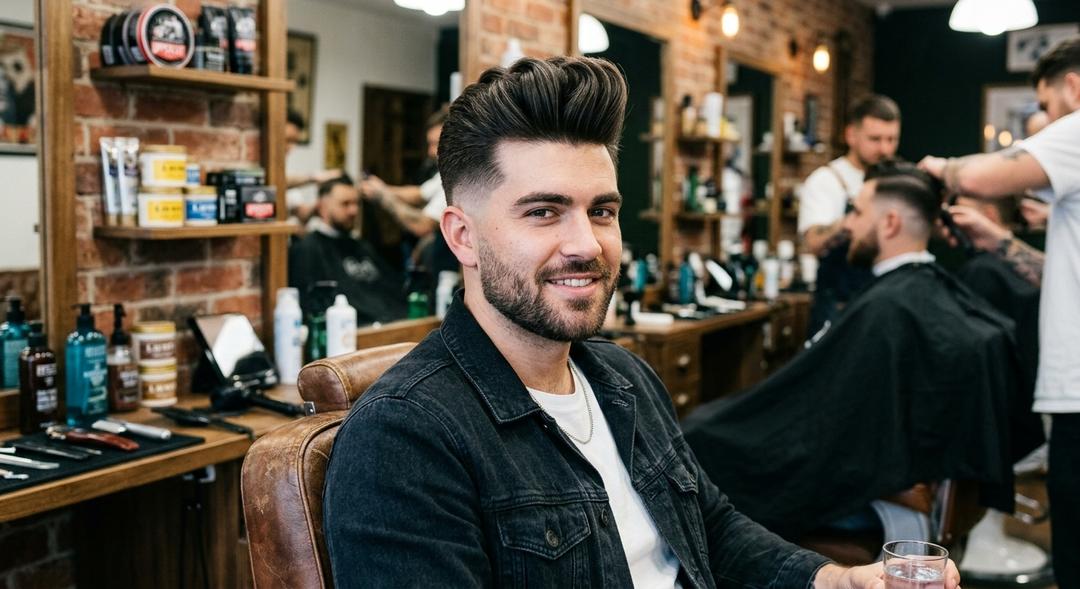
Pompadour Haircut: From Elvis Presley to Kremenchuk Barbershops
The pompadour haircut for men has long ceased to be the preserve of rock stars and hipsters. Today, it's available at any barbershop, and you can find it on the website https://alvibeauty.com/ru-ua/salons/kremenchuk/hairdressers/mensHaircuts , and the line of people wanting it never gets shorter.
The secret to the pompadour haircut is simple: no other haircut creates such a contrast between the disciplined sides and the almost daring freedom on top. It's like a business suit with an unexpectedly vibrant lining—subdued on the outside, full of character on the inside.
Pompadour: The hairstyle that Elvis didn't comb—he styled
Almost everyone who has ever googled the word "pompadour" knows that the Pompadour hairstyle was named after the Marquise de Pompadour, the mistress of Louis XV.
It's no secret that it only gained real popularity among men two centuries later, thanks to Elvis Presley, who introduced the fashion among rock 'n' rollers and bikers.
What's less obvious is that the haircut's structure hasn't changed much since then—except that barbers have learned to make it considerably less fiddly. While styling a pompadour in the 1950s required an hour and a glass of brilliantine, the modern pompadour, with its smooth sides, is held together with a single blow-dry and a drop of paste.
Technique: How to Create a Pompadour Haircut
At first glance, the pompadour haircut follows a simple rule: the sides and back of the head are cut short or shaved, and the crown is left long for volume.
A barber or hairdresser uses a clipper and trimmer along the contour, and then uses thinning scissors to comb out excess weight at the roots so that the hair does not fall out, but holds its shape on its own.
Few people realize that it's the smooth transition between the short sides and the long crown—not the length itself—that determines whether a haircut looks expensive or sloppy. A good barber spends almost more time on this transition than on the rest of the silhouette: it's here that the symmetry of the lines is most often lost if the stylist is in a hurry.
Pompadour, fade, and undercut: how to avoid confusion
Pompadour, fade, and undercut: how to avoid confusion
From the side, it's easy to confuse a pompadour with an undercut, a fade, or a couple of other similar hairstyles—in all of them, the sides are often shortened, and the difference seems unnoticeable. In fact, each haircut has its own distinctive accent:
- An undercut is a sharp, almost graphic contrast between short sides and long strands on top (for more details, see the article "Undercut").
- Fade is the most smooth, smoky disappearance of hair to the skin, without a single visible border (for more details, see the link to the article "Fade").
- Crop - a textured short fringe that is not combed back (for more details, see the link to the article "Crop").
- The Canadian cut is an even length throughout the head, without any pronounced accent on one area (for more details, see the link to the article “Canadian Cut”).
- The quiff is a shorter, more textured cousin of the pompadour.
- British - maintains the same length throughout the head, without pronounced volume on the crown.
The pompadour isn't about the transition itself, but rather what happens at the top: controlled, slicked-back volume. That's why barbers often combine it with a fade or undercut—it's not a violation of the rules, but simply two different solutions for two different areas of the head.
Who suits a pompadour: an analysis based on face shape
A pompadour's face shape works almost like a painting's frame—it doesn't determine whether the work will be successful, but it certainly influences how it's perceived at first glance. An oval face is lucky: it allows you to experiment with any crown height without fear. A round face isn't adverse to a pompadour—on the contrary, the vertical volume visually lengthens the proportions—but barbers usually immediately suggest pairing it with a fade on the sides to enhance the effect. A square face should be a little more careful not with the cut itself, but with the level of smoothness: sharp cheekbones appreciate a mirror-like cut without harsh lines at the temples, otherwise the cut will emphasize what you want to soften. This isn't a limitation or a death sentence—it's simply a reason to discuss with your stylist not "to do or not to do," but "how exactly to style it."
How to style a pompadour yourself, without a barber
Even those who've never worn a pompadour know the basic algorithm for styling it, but they rarely talk about it step by step:
- Wash your hair and dry it with a towel, but not completely dry.
- Apply a small amount of wax or paste, rubbing it between your palms.
- By lifting at the roots rather than smoothing from top to bottom, create volume in the front and crown areas.
- Comb the strands back with a round brush.
- Fix the shape with a hair dryer at medium temperature.
If volume is still lacking, barbers recommend a light backcombing at the roots before waxing—a technique that's almost invisible, but it's what saves fine hair from looking "stuck" by the end of the day. Incidentally, if you're looking for "pompadour haircut photos" before your appointment, consider bringing a daylight photo rather than a glossy poster image—this way, the barber can more accurately assess your hair's texture. And if you're determined to get a pompadour but aren't ready to fight the blow-dryer every day, ask for a short pompadour—a version with minimal volume that holds itself naturally, with little or no styling.
Frequently Asked Questions
What is a pompadour haircut?
This is a men's haircut with short-cropped or shaved sides and back of the head and noticeable volume on the crown, which is combed back.
How to make a pompadour hairstyle?
The barber cuts the contours with a clipper and trimmer, thins the crown for lightness, and then fixes the style with a hairdryer and styling product - wax, gel or paste.
How long do you have to grow your hair for a pompadour?
For noticeable volume on the crown, 5–7 cm of length is usually enough; with shorter hair, the effect will be noticeably weaker.
What is the difference between a pompadour and a crop or undercut?
A crop is about textured bangs that aren't styled back, an undercut is about a sharp contrast in length at the temples, and a pompadour is defined by volume and combing at the top.
How often should you get your haircut updated at the barber's?
On average, once every 3-4 weeks, so that the contour on the temples and the back of the head does not lose its definition, and the top length remains manageable when styling.