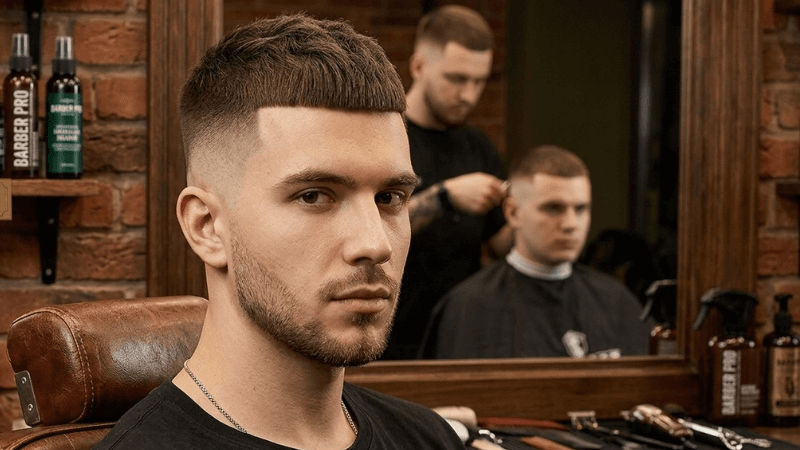
Caesar Haircut for Men: Who It Suits and Which One to Choose
Some haircuts demand immediate attention due to their volume or complex styling. The Caesar cut is more relaxed. It's recognizable by its short top, hair swept forward, and neat bangs. The men's Caesar cut is prized for its put-together look: it typically requires less time in the morning than longer styles.
In the AlviBeauty catalog, you can browse the men's haircuts section and choose a hairstylist in the Men's Haircuts Kremenchuk section. If you're considering a Caesar cut , it's best to decide in advance not whether it suits you or not, but rather which style you want:
- classical,
- short,
- textured,
- or with a more noticeable transition.
What does a Caesar haircut look like and why is the bangs so important?
The basic design of a Caesar haircut is simple: the crown is kept short, the sides and back are cut shorter, and the hair on top is swept toward the face. But it's the bangs that give it its distinctive look. In the classic version, they're straight or slightly softened, with no high rise at the roots.
The bangs here act as a frame for the graphic: a few millimeters change, and the effect is completely different. A short line creates a more defined silhouette, a slightly longer length softens the forehead, and texture removes excess geometry. Therefore, a Caesar cut isn't a rigid pattern. The stylist adjusts it to the direction of hair growth and the desired contour.
Barbers and hairdressers often recommend a top length of approximately 2.5–5 cm, but this isn't a universal standard. It's more practical to see how the hair falls forward without constantly fighting against natural growth. This is more important than a fancy number in the description.
Classic, short and textured Caesar
A classic Caesar cut maintains a smooth transition between the top, sides, and back. A short Caesar cut creates a tighter outline and typically requires less styling. A textured version allows for more movement on top and better accommodates natural waves.
Sometimes you'll also see the term "Caesar cut." The name is the same, but the result is determined by three factors: the length of the top, the shape of the bangs, and the transition. These factors make the Caesar cut look sharp, soft, or more athletic.
What is the difference between the top length and the fringe line?
The shorter the crown, the easier it is to maintain a cohesive silhouette. Longer hair adds texture and allows for subtle variations in the direction of the strands. Overly long bangs gradually draw the hair into a crop or simply a short haircut with bangs.
When looking for a Caesar haircut photo, it's helpful to look beyond the frontal shot. A side view better shows the short sides, the transition in length, and the shape of the back. This is where you can tell whether you're looking at a Caesar or a similarly styled haircut.
When you need a smooth transition at the temples and back of the head
The smooth transition softens the shape and connects the crown with the short sides. A more noticeable contrast adds a modern touch, but doesn't automatically turn the Caesar into a fade. A fade is a transitional technique, and the Caesar is primarily recognized by the direction of the hair on top and the bangs.
A transition is like sharpening: it changes the impression of the outline, but shouldn't interfere with the main shape. Therefore, it's more helpful for the artist to show the desired transition height and top length than to ask for an exact replica of someone else's photo.
Who suits the Caesar haircut based on their face shape and hair type?
A Caesar cut is often considered for oval, square, and oblong faces, but the face shape shouldn't be a barrier. For a round face, you can keep a little more height on top and lighten the bangs; for a high forehead, leave the front line more prominent.
On straight and coarse hair, the contours are more clearly defined. On soft or wavy hair, a textured version works better. A Caesar cut on curly hair is also possible, as long as you leave enough length for the curl and don't try to force it into a perfectly straight line.
It's more helpful to ask not "who can't have a Caesar cut?" but rather what shape can be achieved with specific hair. This approach doesn't limit the individual and gives the stylist more room for fine-tuning.
What is the difference between Caesar and Crop?
The Caesar cut and crop are closely related: both are short, can be paired with short sides, and are often worn with hair forward. Therefore, they can be easily confused.
The Caesar cut typically has a smoother, more composed front. Crop cuts often feature more texture, a jagged edge, and a more noticeable contrast at the top. Modern versions can be more convergent, so it's not worth judging based on the bangs alone.
The practical guide is simple: if you want a crisp, short fringe and a subtle geometric shape, look toward a Caesar cut; if you want a more textured top, a crop is more often the choice. It's best to keep the comparison brief, lest you confuse the two distinct intentions.
How to style a Caesar cut and when you can do without styling
For a short style, it's often enough to simply blow-dry it in the direction of hair growth and tweak it with your fingers. If you want texture on top, you can add a bit of matte paste or another lightweight product. The goal is to maintain the direction, not make the bangs stick out.
A hairdryer isn't always necessary. It's helpful if your hair grows upward, spreads out to the sides, or you want a little more volume at the crown. First, use the air to create the desired direction, then add product if needed.
The most convenient option is one that respects the natural direction of hair growth. A well-chosen length saves more time than applying a strong hold every morning.
How often should I trim my hair and maintain a clear outline?
Some hairdressers and barbers use a 3-4 week guideline. This is a normal starting point, but not a universal rule. Some people lose their fringe faster, while others grow their bangs out sooner.
The signal for a correction is simple: the fringe line is losing its shape, the transition at the temples is becoming heavier, and the back of the head is losing its clear contour. Sometimes, it's enough to refresh the edges rather than change the entire length.
Frequently Asked Questions
What is the difference between a Caesar haircut and a crop?
A Caesar cut typically has a straighter fringe and a more relaxed top. A crop often has more texture and a jagged edge.
Who suits the Caesar haircut?
The Caesar cut can be adapted to different face shapes by varying the length of the bangs, the height of the top, and the fade at the temples. The direction of hair growth and texture are also important.
Can you do a Caesar cut on curly or wavy hair?
Yes, usually they leave a little more length on top and soften the front line so as not to fight the natural curl.
How often does a Caesar haircut need to be trimmed?
Typically, 3-4 weeks is the target. The exact timeframe depends on the rate of hair growth and how quickly the bangs and trim are lost.
What hair length do you need for a Caesar?
There's no set number. Descriptions suggest a range of approximately 2.5–5 cm at the top, but the stylist chooses the length based on the hair texture and the desired fringe shape.