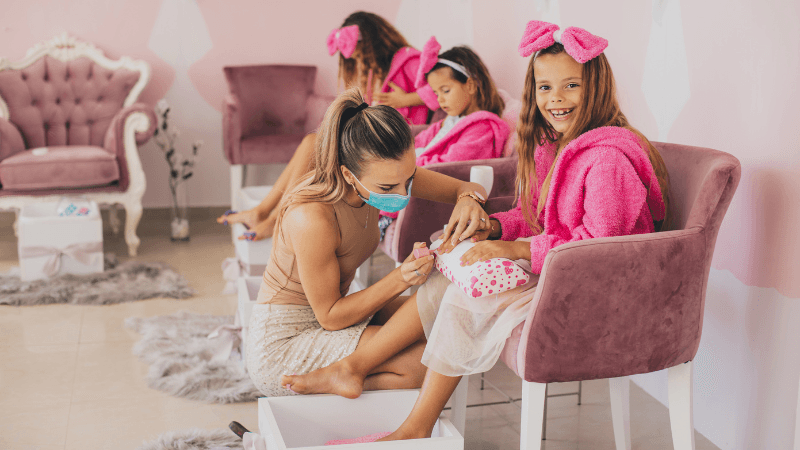
Children's manicures and pedicures: what age is it possible and how to choose a safe specialist
Children's manicures and pedicures are a topic that often leaves mothers divided: some forbid everything until they reach puberty, while others take their three-year-old daughters to get gel polish. The truth lies in the middle—and it's far more practical than either of those extremes. Alvibeauty Studio welcomes young clients, and we know the questions parents ask most frequently. You can book a children's manicure or pedicure appointment here—on the Alvibeauty website. Nail service in Kyiv, Dnipro, Kharkiv, and other cities in Ukraine.
Why does a child need a manicure and pedicure? It's not a whim.
When a four-year-old daughter reaches for her mother's nail polish, it's not a request for a grown-up manicure. It's a signal that it's time to explain: hands and feet require care just like teeth and hair. For a child, manicures and pedicures are about hygiene, not beauty. Nail care is a habit, just like brushing your teeth.
Hangnails are a gateway for infection. Toenails that are too long are a surefire way to get an ingrown nail. Dirt under your nails is another reason to wash your hands, but it doesn't always help without careful trimming. Regular grooming solves all three problems at once.
There's also an unobvious bonus. Children who bite their nails—onychophagia occurs in one in three children under ten—almost always stop after their first manicure. Subconsciously, people don't want to ruin beautiful nails. Children's nail polishes also contain bitter ingredients—natural fruit resins—that make the habit even more unpleasant. Nail biting is also a sign of anxiety or stress. A manicure can help break the habit, but it's also worth talking to your child about what's bothering them.
How do children's nails differ from adults'?
Before talking about age, it is important to understand why it matters at all.
Children's nails are thin, soft, and grow significantly faster than adults'. Most importantly, they haven't yet fully formed. This development continues until approximately 14-15 years of age, when the body completes its adolescent hormonal cycle. Before this point, any aggressive action—filing, grinding, or chemical coatings—can disrupt the growth zone. This zone is called the matrix, and damage to the matrix results in permanent nail deformity.
The cuticle and pterygium—the thin film that grows from beneath the cuticle—serve a dual protective function in children: they protect the nail matrix from infection and mechanical injury. This is why trimmed manicures are not suitable for children. And this is why cutting the nail right down to the root is a costly mistake.
At what age can children get a manicure? What is allowed at each age?
There's no set age limit for manicures for children . There are stages, each with its own rules.
- From birth to two years. Hygiene only. Nails are trimmed with scissors with rounded ends or special nippers—it's easiest to do this while the child is sleeping. Fingernails are trimmed round, and toenails are trimmed straight. This is important: a straight cut on toenails is the main preventative for ingrown toenails. The pterygium is left alone.
- Ages three to five. Gently file with a soft file with a grit of 240–360. No metal files—only plastic or glass ones. Cuticles are pushed back with an orange stick; they are not trimmed. Use only children's nail polish without toxic ingredients. Leave a free edge of about two millimeters.
- Ages six to nine. A light water-based nail polish is added to the filing process—it washes off with soap and water and requires no remover. No UV gels or chemical coatings. No glitter or stickers—please, they're safe.
- Ten to thirteen years old. Regular, high-quality polish—free of formaldehyde, toluene, and phthalates. These aren't just marketing terms, but real, harsh substances that even adults shouldn't use, much less children. A strengthening, clear base coat is essential—it prevents the pigment from soaking into the still-thin nail plate. Gel polish—no.
- From fourteen to sixteen years old. Gel polish is possible with some caveats: the nail plate is almost fully formed, but hormonal levels are still unstable. This means the coating may not last as long and may react unpredictably. Nail extensions are a no-no, definitely not until age sixteen.
- Ages sixteen and up. As an adult, taking into account the condition of your nails and the nail technician's recommendations.
After every coat—even children's polish—your nails need a rest of one to two weeks without any application. This isn't a beauty rule, it's a health rule.
What not to do in a children's manicure and pedicure
Some prohibitions are obvious, while others surprise even experienced parents:
- Gel polish for children under 14. It's not just a chemical issue. Removing gel polish requires filing or soaking, both of which can damage the growth zone. A child's thin nail plate, when exposed to a harsh base coat and a lamp, can peel, deform, or cause an allergic reaction. Hormonal imbalances further increase the unpredictability of the reaction.
- Sanding and polishing the nail plate is strictly prohibited. This involves removing the top layer of the nail—adults do this to smooth out any unevenness. In children, this layer is essential: it protects the delicate nail plate from external influences.
- Hardware manicure for children under 10. The cutter is designed for adult cuticles with thick layers. Children's skin is too delicate, and there is a high risk of damaging the cuticle matrix.
- Trim your cuticles. Before age 15, push them back with an orange stick or soften them with a fruit acid remover. The cuticle protects the growth zone. If you cut it, you lose that protection, creating hangnails and risking inflammation.
- Trim your nails after a bath. It sounds strange—it seems like steamed nails are easier to trim. In fact, a swollen nail changes shape and the free edge becomes blurred. Trim more than necessary, and the nail plate will be permanently shortened. Trim only dry nails.
Nail extensions are recommended for children under 16. No exceptions. Artificial materials impair the nail's ability to breathe and create a breeding ground for fungus—especially dangerous while the nail is still developing.
Children's pedicure: how is it different from a manicure?
All competitors only talk about hands. Meanwhile, children's pedicures on feet require special attention—and special rules.
The main difference: toenails are cut strictly straight, not rounded. A straight cut is the main preventative for ingrown toenails. This is the most commonly violated fundamental rule—and it is precisely this that leads to ingrown toenails. The corners are not cut or rounded. The free edge is left slightly longer than necessary.
Children's feet sweat more than their hands, especially in closed shoes. This creates a moist environment under the surface, increasing the risk of fungus. Therefore, pedicures are done more frequently than manicures: every two to three weeks. Afterward, apply cuticle oil and wear cotton socks.
Don't: colored nail polish on toenails under 10 years old – for the same reasons as for hands. Gel polish on feet is especially a no-no: removal requires prolonged soaking, which is too harsh for children's feet.
If your big toenail has already started to grow in, you should see a pedicurist immediately, not try home care. Read more about this in our article: Pedicure for Ingrown Toenails: When to See a Professional and When to See a Podiatrist
How to prepare your child for their first visit
The first visit to the salon is everything. If a child is scared, they may wait years for the next visit. If everything goes well, the manicure will become a favorite ritual.
A few rules that work.
Explain in advance what will happen. Not "they'll paint your nails"—but step by step: first, they'll wash your hands, then they'll file your nails with a special soft file, and then they'll apply a fruit-scented oil. Specifics relieve anxiety.
First visit
The first visit is just an observation session. The child sits nearby while the mother gets her manicure. They watch, touch the instruments, and get used to the sounds and smells. There are no procedures at all—just an introduction.
Game format
A playful format. Brightly colored tools, a beautiful towel, the ability to choose your own nail polish color—these aren't just details, they're the essence. The child should want to come back.
A good master doesn't start with nails
A good stylist doesn't start with nails. They start with a conversation. They introduce themselves, show the tools, and explain that nothing will hurt. Only when the child is relaxed and trusting does the procedure begin. If the stylist immediately takes the child's hand without making contact, that's a red flag.
The procedure should be short
The procedure should be brief. A small child can't sit still for an hour. A good pediatrician does everything quickly and precisely—without unnecessary movements.
How to choose a salon and stylist for your child
A children's manicure is no more difficult than choosing a professional for a child than an adult's. However, the requirements are higher. For information on choosing a good professional, read the article "How to Choose a Manicurist: What to Look for ."
Sterilization - autoclave only
A quartz lamp and rubbing alcohol are not sterilization. For children, an autoclave is recommended. Instruments must be delivered in sealed kraft bags and opened in front of you. If the technician removes instruments from the box, leave.
A specialist with experience working with children
This isn't the same as simply being a good manicurist. Working with a restless child, establishing rapport, and redirecting attention is a separate skill. Ask directly: have you worked with children before? How do you handle a child who cries or pulls away?
Hypoallergenic materials
Children's nails and skin are more sensitive. Ask to see the ingredients of the polishes you use—they are free of formaldehyde, toluene, and phthalates. Water-based children's polish is ideal for little ones.
Ventilation in the office
Ventilation in the office. The smell of nail polish and remover in a confined space can be stressful for a child and can increase the risk of allergies. The office must be properly ventilated.
Disposable consumables
Disposable consumables. Nail files, orange sticks, and wipes are disposable only. A fresh towel is provided for each client.
Alvibeauty's specialists work with children and know that the first experience should be positive. A good specialist will repeat their nails without question —and will be honest if the condition of your child's nails requires a specialist consultation rather than a manicure. For information on choosing a manicure technique, read the article " Hardware or Combination Manicure: What's the Difference ."
Frequently asked questions about children's manicures and pedicures
At what age can children have a manicure?
Hygienic manicures are recommended from birth. Filing and cuticle treatments are recommended from age three. Children's water-based nail polish is recommended from age six. Regular nail polish is recommended from age ten. Gel polish is recommended from age fourteen, with some restrictions.
Is it safe for children to get pedicures?
Is it safe for children to get pedicures ? Yes, if done correctly. Toenails are cut straight across, and only children's nail polish is used, and only after age ten. A pedicure every two to three weeks is more important than a manicure—it prevents ingrown toenails.
Why can't children use gel polish on their nails?
Why shouldn't children use gel polish ? There are three reasons. First, the nail plate is still developing, and the chemical treatment disrupts this process. Second, removal requires filing, which damages the growth zone. Third, hormonal imbalances make the reaction unpredictable.
What should not be done in a children's manicure?
Cut cuticles, file nails, get hardware manicures until age 10, cut nails after bathing, get extensions until age 16, and use gel polish until age 14.
How often can a child get a manicure?
Hygienic manicures – every two weeks as the nails grow out. Pedicures – every two to three weeks. After each application, take a one to two week break without polish. How often can you get a manicure? Recommendations from professionals .
Read also
- Pedicure for ingrown toenails: When is a professional enough, and when is a podiatrist needed?
- Hardware or combination manicure: what's the difference?
- How to prepare for a manicure or pedicure before your appointment
- Nail care at home between nail appointments
- How to choose a manicurist in Kyiv: what to look for