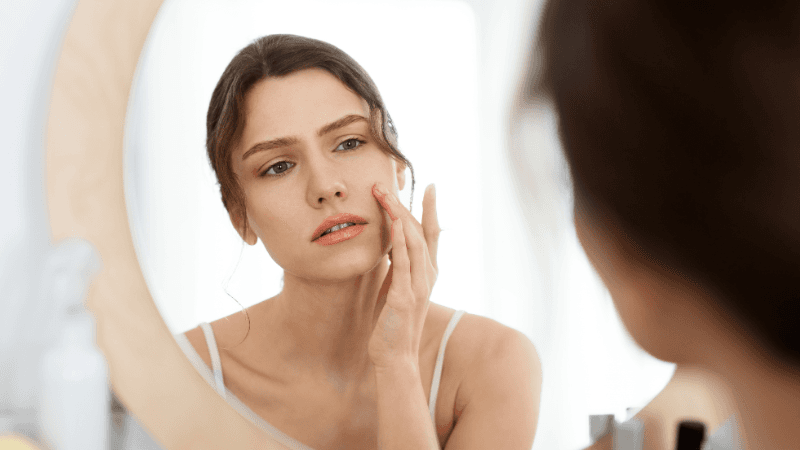
Why does my facial skin become rough and what can I do about it?
Just recently, your foundation applied smoothly, but now it feels like your fingers are catching on your cheeks or chin. If you're trying to figure out why your skin has become rough , don't rush to get out your scrub or buy another jar of cream. This change can have several causes, and your skincare routine depends on what's happened to your skin.
If you want to show your skin to a specialist, you can find cosmetologists in Brovary on the website https://alvibeauty.com/ru-ua/salons/brovary/cosmetology .
Rough facial skin: what exactly has changed
We often use the word "rough" to describe different sensations. For one woman, small, dry flakes appear. For another, her face looks normal, but the surface feels rougher to the touch. For a third, along with the roughness, there's tightness, redness, or sensitivity.
Therefore, rough facial skin alone doesn't explain the cause. It's helpful to first look at the accompanying symptoms.
If there's noticeable flaking, the skin may be losing moisture and retaining it less effectively in the stratum corneum. If the surface has simply become rougher, dead skin cells may be more noticeable. And if your face stings and turns red after using your usual cream or serum, it's worth checking whether your skincare routine has become too intense.
Roughness is often associated with dryness, dehydration, and a weakened skin barrier. When skin has difficulty retaining moisture, the surface may feel less smooth, and your usual cosmetics may suddenly feel uncomfortable.
Why can facial skin suddenly become rough?
The most useful question here is not "which cream should I buy?", but "what has changed recently?"
Common causes can be found among familiar things:
- hotter water, a new cleansing gel, too frequent cleansing, scrubs, acids, peels, or several active products at the same time;
- dry indoor air, heating season, cold, wind, sudden weather changes, or a new cosmetic product that caused tightness.
If your facial skin feels rough to the touch after using acids, a scrub, or a new active product, don't automatically consider this a normal stage of renewal.
A mild, short-term reaction is not the same as persistent irritation. If your skin burns for a long time, becomes noticeably red, feels very tight, or becomes increasingly dry, it likely requires a more gentle treatment.
What happens to the skin barrier and stratum corneum?
Think of the top layer of skin as a carefully constructed wall. The cells are like bricks, and the lipids between them help retain moisture and protect the surface.
When the protective barrier is functioning properly, the skin retains water better and reacts more calmly to external irritants. If lipids become deficient or the barrier is damaged, moisture evaporates more quickly.
This is where the familiar sensations arise: tightness, dryness, roughness, increased sensitivity.
The stratum corneum is also important. Its surface is constantly renewed: old cells gradually shed, and new ones take their place. If this process is disrupted or the skin is exfoliated too vigorously, its smoothness may disappear.
Therefore, concepts such as skin barrier, stratum corneum, skin lipids, NMF and transepidermal water loss are interconnected.
You don't need to memorize the terms. The main thing is to understand the principle: a rough surface doesn't always mean the skin needs to be scrubbed harder or exfoliated more often.
Why does the cream soften the skin, but the roughness remains?
It's a familiar situation: you apply cream in the evening, your face feels softer, but in the morning you can feel the roughness again with your fingers.
The cream may temporarily relieve the feeling of dryness and help the skin retain moisture. But if the underlying cause persists, the problem will return.
For example, if your skin is exposed to hot water, harsh cleansers, or multiple acidic products every day, a moisturizer alone isn't enough.
When it comes to dryness and roughness, it's important to look at your overall skincare routine, rather than looking for just one "saving" product.
Exfoliation deserves a special mention. If dead skin cells have accumulated on the surface, gentle exfoliation can sometimes be appropriate. However, red, itchy, or irritated skin should not be literally "polished off."
It's so easy to get the opposite effect: even more sensitivity and dryness.
What to check first in care
Don't change your entire makeup bag in one evening. The more products you remove and add, the more difficult it will be to understand what exactly affected your skin.
Start with four things:
- Wash your face with warm, not hot, water and use a gentle cleanser;
- temporarily reduce the use of products that cause burning, dryness, or severe tightness;
- leave a clear moisturizer and daytime sun protection;
- Do not rub your face with a towel, scrub or brush in an attempt to mechanically remove roughness.
After this, observe your skin for several days.
If it feels less tight, sensitivity decreases, and the surface gradually becomes softer, then simplifying care has been helpful.
It's much easier to understand how to remove roughness from your facial skin than to test a new peel, serum, mask, and cream all at once.
How to get smooth skin without excessive exfoliation
The question of how to make facial skin smooth often leads to one obvious solution: take a scrub or acid and exfoliate the surface more intensely.
But smoothness depends not only on the number of keratinized cells.
If the protective barrier is irritated, the skin first requires a more relaxed regimen. In this situation, additional exfoliation may delay results rather than speed them up.
The goal of this treatment is to gradually restore comfort: reduce dryness, help the skin retain moisture, and eliminate irritants.
If roughness appears after an active skincare routine, it's sometimes helpful to simplify your routine for a while. Once your skin calms down, you can gradually reintroduce active products and monitor the reaction.
And one more thing. Living skin always has pores and a natural microrelief. It doesn't have to look like a filtered photograph. Smooth skin is, first and foremost, skin without noticeable dryness, irritation, or an unpleasant roughness to the touch.
When you shouldn't try to fix rough skin yourself
If the problem appeared after a new remedy and quickly subsides after its discontinuation, it is often enough to reconsider the care.
But there are situations when it is not worth experimenting further.
If the roughness persists for a long time, quickly worsens, or constantly returns without an obvious cause, it is best to discuss the condition of your skin with a specialist.
This is especially true in cases where severe itching, pain, noticeable swelling, oozing, deep cracks, crusts, or spreading rashes occur.
Roughness is a symptom, not a diagnosis. It can accompany various skin conditions, so if symptoms are severe or persistent, the cause should be assessed individually.
Frequently Asked Questions
Can skin be rough without flaking?
Yes. Sometimes the skin appears completely normal, but a rougher surface can already be felt with your fingers. Roughness may appear before noticeable scaling or be accompanied by changes in the stratum corneum without noticeable flaking.
Why does my skin become rough after using acids?
This could be due to overuse of acids, high concentrations, a combination of several active ingredients, or an individual skin reaction. If burning, dryness, and redness occur simultaneously, it's best to temporarily reduce your active skincare routine.
Can you remove rough skin with a scrub?
Not always. If your skin is dry, sensitive, or irritated, mechanical friction can make things worse. First, it's important to understand why the roughness is occurring.
Why doesn't moisturizer remove roughness?
Because cream doesn't always address the underlying cause. If the skin continues to be irritated by hot water, harsh cleansing, or excessive use of active ingredients, the moisturizing effect may only be temporary.
How do you know if your current skincare routine isn't suitable?
Pay attention to any recurring burning, increasing tightness, redness, itching, or worsening of the condition after using a certain product. This is especially true if the reaction occurs every time you use it.
Can oily skin be rough?
Yes. Active sebum production doesn't mean the skin retains moisture well. Oily skin can also be dehydrated, irritated, and rough to the touch.
When should you see a dermatologist for rough skin?
If the roughness does not go away, becomes more severe, or is accompanied by severe itching, inflammation, pain, cracking, oozing, or a spreading rash, it is best to consult a doctor.