How to choose a CRM system for business and services
If you work in Thailand and are wondering how to choose a CRM for the service industry , it's important to move away from the idea of "just picking the most popular system." In practice, a CRM should address the specific needs of a service business: request processing, online booking, customer service, team scheduling, and financial control.
For salon owners, private stylists, and service businesses, CRM isn't "just another program," but a working tool that helps them avoid losing leads, reduce no-shows, and build consistent repeat visits.
You can see how such processes are typically structured in CRM systems for the service industry at https://alvibeauty.com/ru-th/crm_info—without marketing promises, but with an emphasis on the practical logic of the work.
What is CRM and why does business and services need it?
A CRM system for businesses and services is a single space where requests, clients, client profiles, visit history, notes, and communications are collected. The CRM allows you to see your sales funnel, deal stages, leads, and the status of each request.
For the service sector, the following play a key role:
- schedule and shifts;
- loading masters;
- control of cancellations and transfers;
- customer records and return visits.
This is why CRM for business and CRM for the service sector directly impacts revenue, and not just “convenience.”
Key criteria for choosing a CRM for business and the service sector
When the question arises about how to choose a CRM system for business and services, focus not on marketing, but on daily work scenarios.
Interface and simplicity
If a CRM is complex, the team won't use it. Simple actions should be performed quickly: requests, records, transfers, notes.
Appointment and calendar
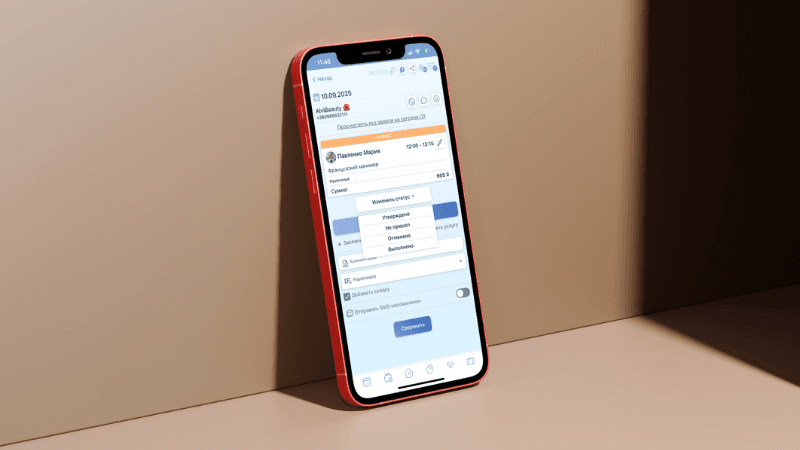
For services, a CRM with online booking, an online appointment calendar, online client booking, and 24/7 booking capabilities are critical. This reduces routine and lost requests.
Customer accounting
CRM customer accounting and a CRM customer database with a card, history, and customer segmentation are required.
Communications
Notifications, automated messages, templates, and reminders are essential for reducing no-shows. A CRM with online booking and reminders is especially important.
Analytics and finance
Even basic CRM sales analytics, CRM financial analytics, CRM income and expenses, and CRM financial accounting allow you to manage your business, rather than guessing.
When CRM is really not needed – honestly and to the point
It's important to be clear: a CRM system for businesses and services isn't always necessary at the start. If you work alone, handle a few clients a day, keep records manually, and don't experience lost requests or scheduling confusion, implementing a CRM may not yield significant results.
A CRM begins to deliver real value when problems arise: requests from messaging apps are lost, clients forget about appointments, records overlap, and repeat visits aren't tracked. At this point, the system ceases to be just a program and becomes a service business management tool.
Examples of CRM systems with key functions in 2026
In 2026, the best CRM for services isn't an overloaded "combine," but a system that seamlessly manages clients, records, teams, and reports.
When comparing, pay attention to:
- CRM online booking and flexible slot management;
- CRM for tracking clients and repeat visits;
- CRM for personnel and schedule management;
- CRM sales analytics and clear reports;
- CRM integration with the website, messengers and payments;
- CRM with a mobile app and CRM for working on the go.
For growing projects, it's important that the CRM supports CRM scalability and CRM automation of business services, rather than requiring a system change after a year.
Benefits of CRM for the Beauty and Services Industry
In the beauty sector, the impact of a CRM is most noticeable. CRMs for beauty salons and CRMs for service professionals allow you to get things in order within the first few weeks.
Key benefits:
- fewer errors in recording and scheduling;
- application and lead control;
- no-show reduction;
- increase in repeat visits;
- Transparent CRM reports, dashboard, KPIs, average order value, LTV, and retention.
In fact, CRM helps you avoid losing clients and build a service, not just “accounting.”
Stages of CRM implementation: from setup to analytics
Even the best CRM won't work without a clear plan.
Stages of CRM implementation:
- Describe the processes: from application to payment.
- Set up services, schedules, CRM personnel and schedule management.
- Transfer the CRM customer database and clean up the data.
- Connect notifications and communications.
- Define metrics: applications, sales funnel, average order value.
- Run the test and collect feedback.
Typical mistakes:
- implement everything at once;
- fail to appoint a person in charge;
- ignore team discipline.
How to Choose a CRM System for Business and Services in Thailand: A Practical Guide
When choosing a CRM system for business and services in Thailand, focus on real pain points: recording, clients, scheduling, request tracking, and basic analytics.
For example, consider the AlviBeauty solution— a CRM for the service industry with a focus on online booking, client tracking, team management, sales analytics, finance, communications, and marketing. The system is suitable for both solo professionals and salons seeking scalability without disruption.
Frequently Asked Questions
Which CRM is best for a service business?
The best CRM for a service business is one that offers stable online booking, customer tracking, appointment reminders, and basic reporting on requests and revenue.
What's important in a CRM for service professionals and salons?
For professionals and salons, a convenient appointment calendar, quick rescheduling, a client card with visit history, and minimal administration time are essential.
How to avoid losing applications from instant messengers and social networks?
To avoid losing leads, a CRM for the service industry should aggregate requests from all channels into a single list and display a transparent sales funnel.
What CRM reports for services are most needed?
In a CRM for services, the most important things you need are reports on requests, technician workload, revenue, repeat visits, and average order value.
How much does CRM cost for the service and business sectors?
The cost of CRM services for businesses depends on the functionality and size of the team, but losses due to chaos, missed requests, and no-shows almost always cost more.